Sownd - Cymru yn Fenis / Wales in Venice
Manon Awst and Dylan Huw
9 May 2026 - 22 November 2026
10.00 - 18.00hrs.
Closed Mondays
For the 61st International Art Exhibition – La Biennale di Venezia, Manon Awst and Dylan Huw represent Cymru yn Fenis / Wales in Venice with the collaborative project Sownd, supported by lead organisations Oriel Davies and Oriel Myrddin.

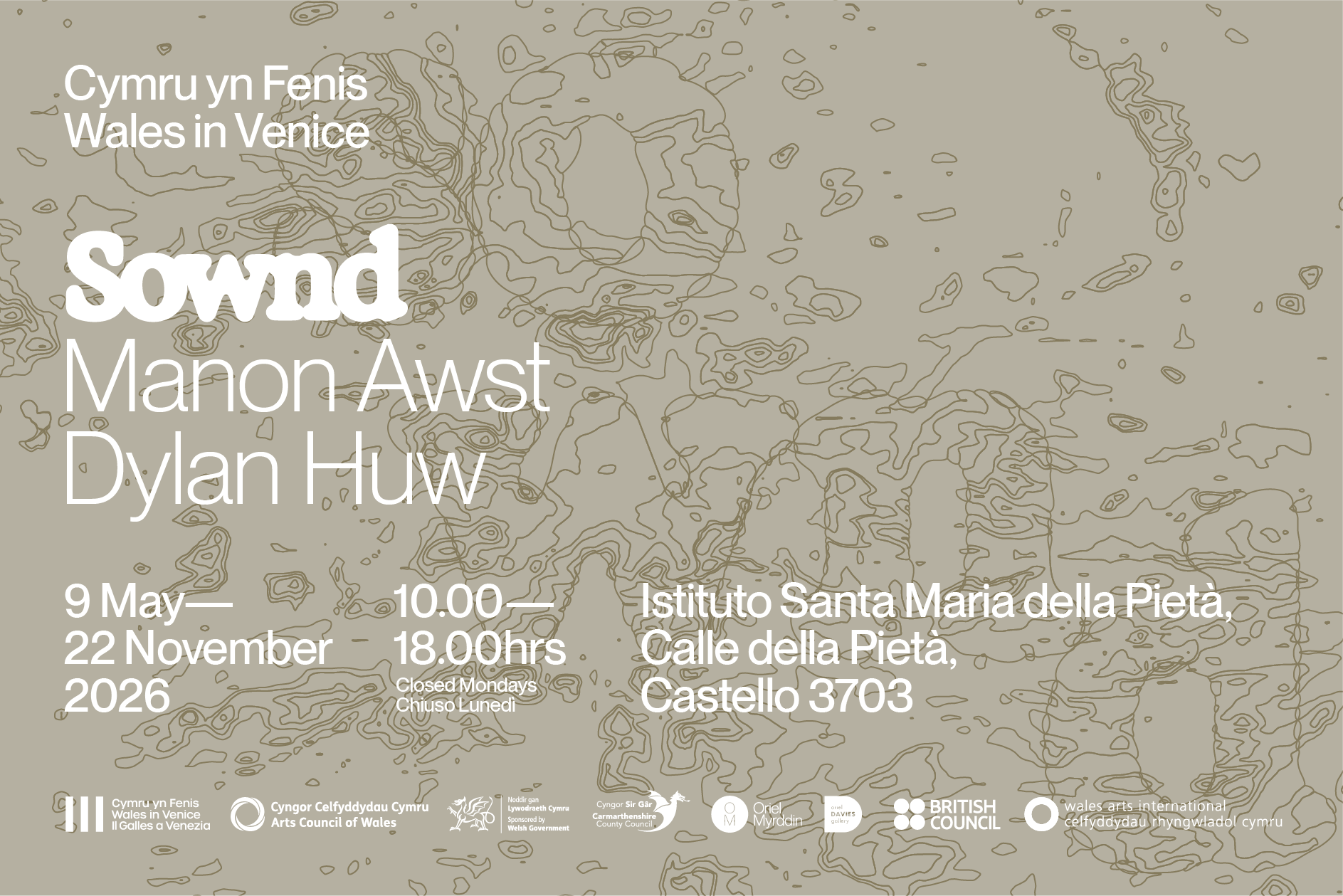
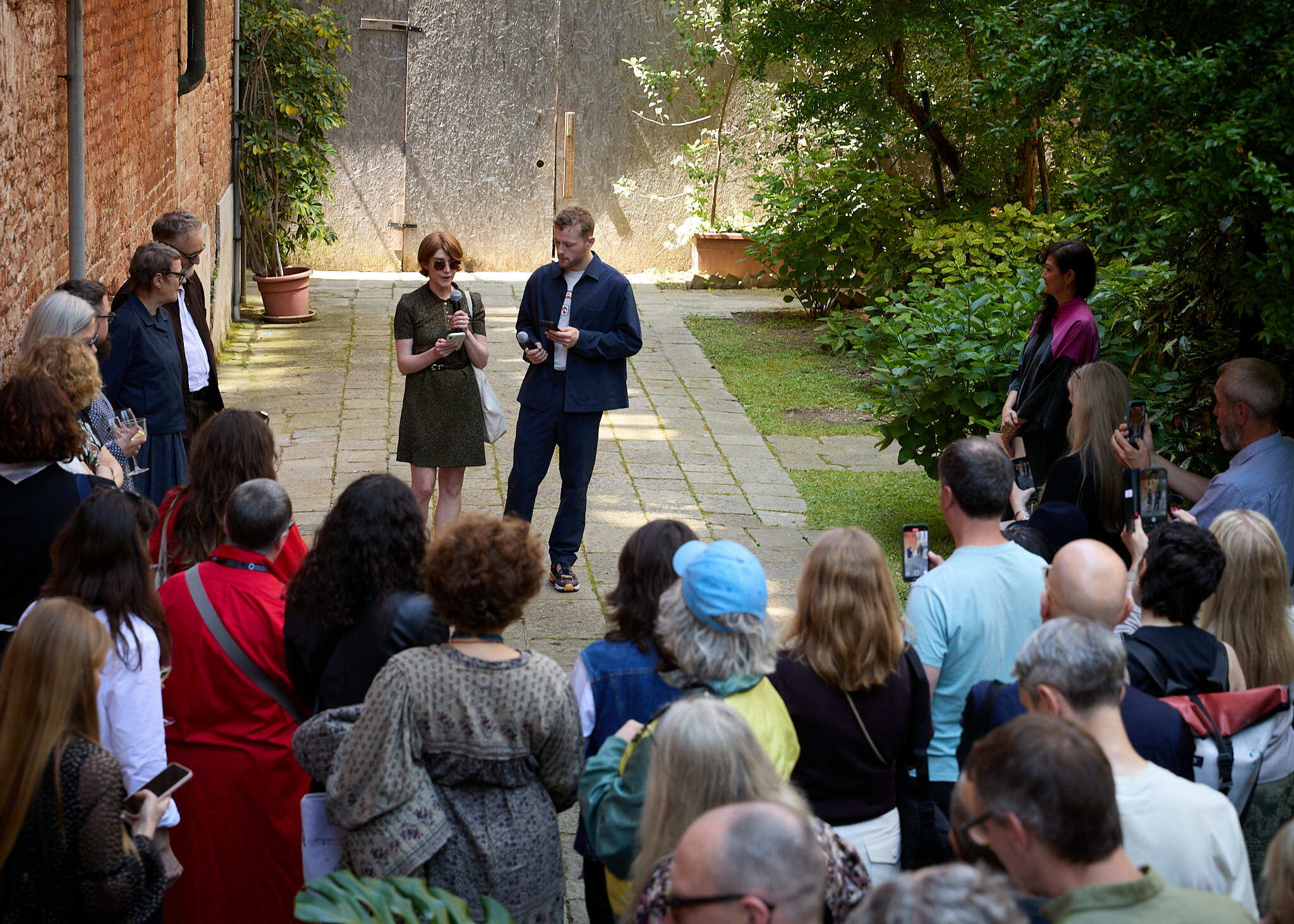
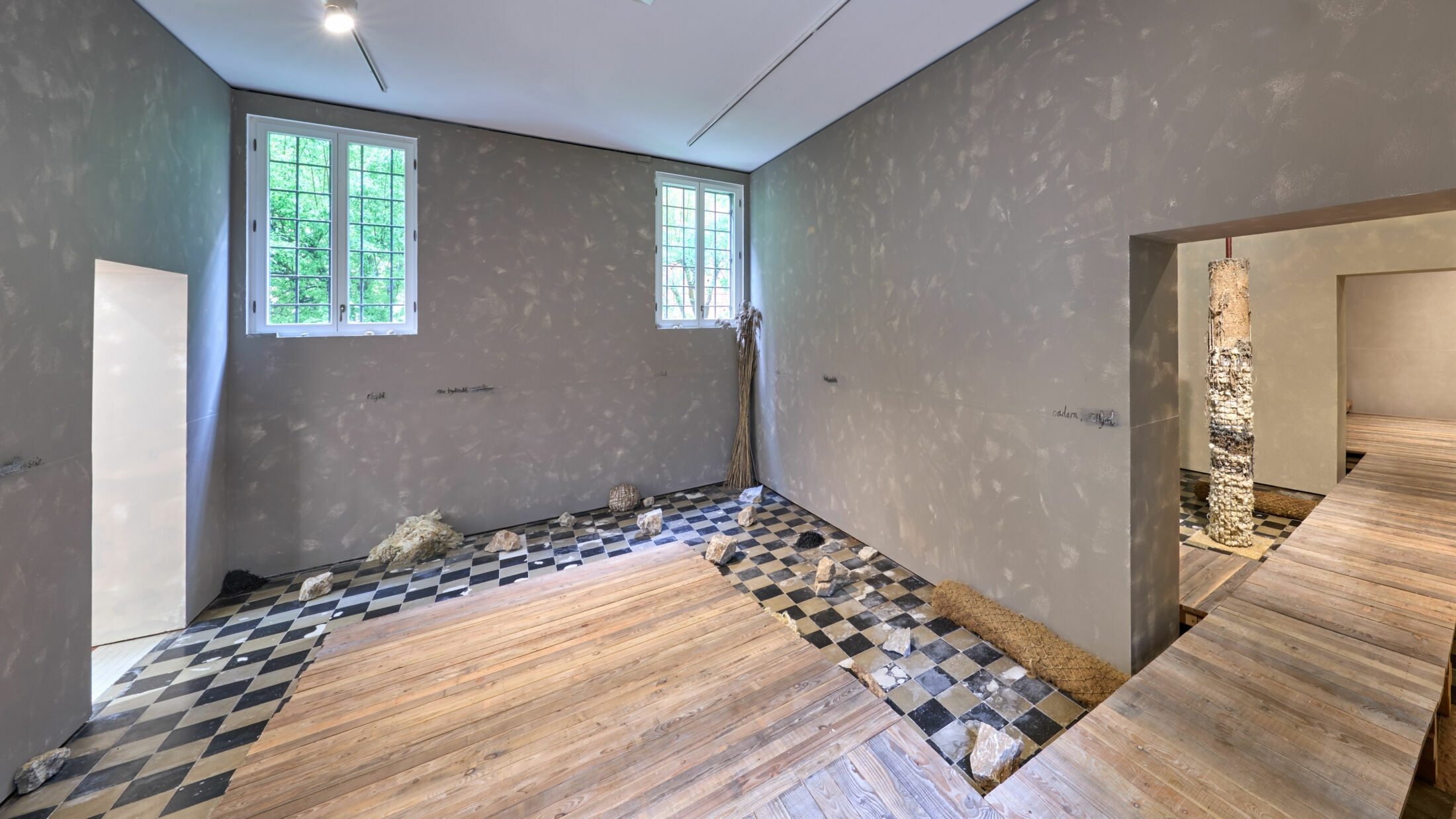
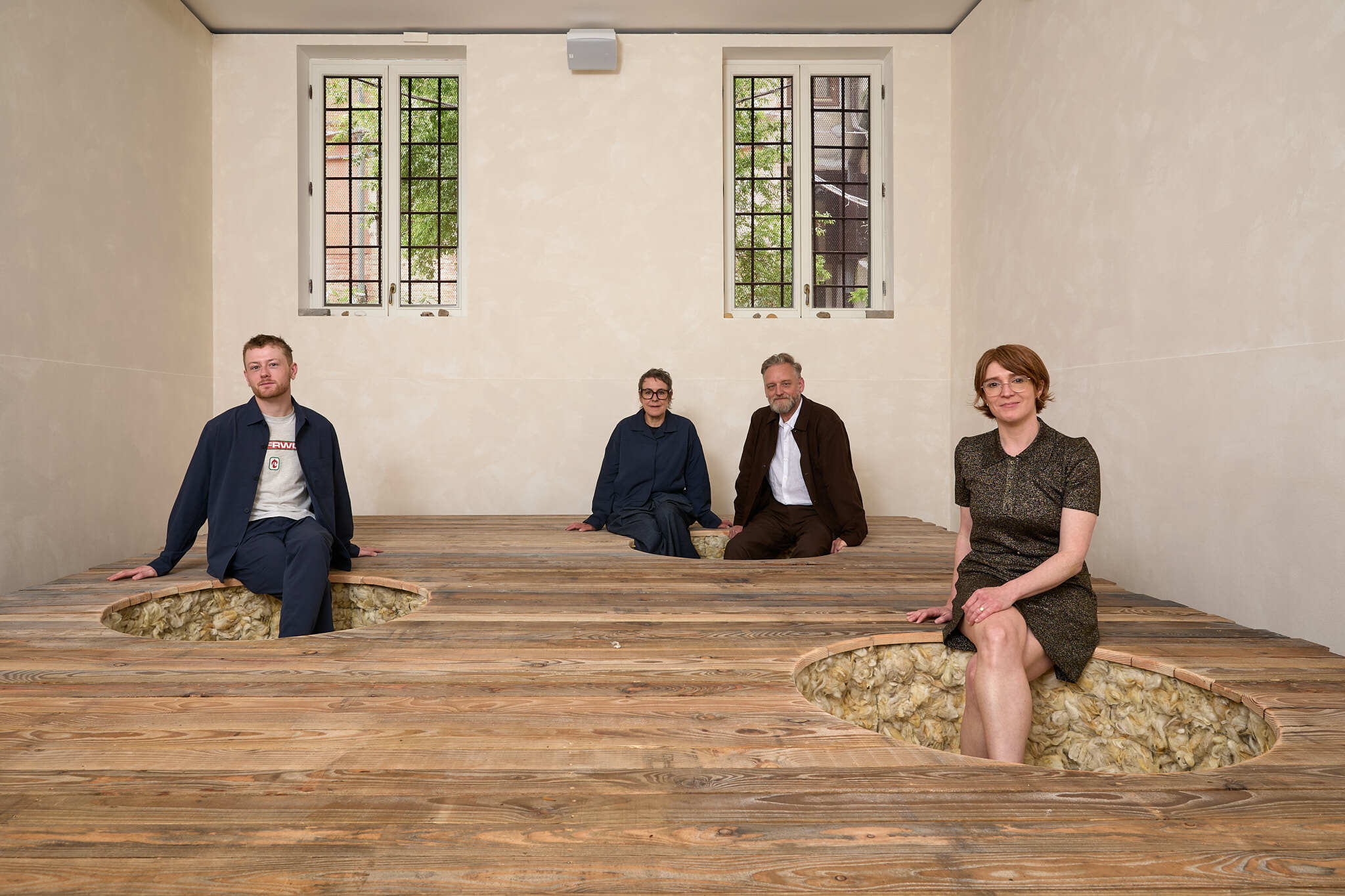
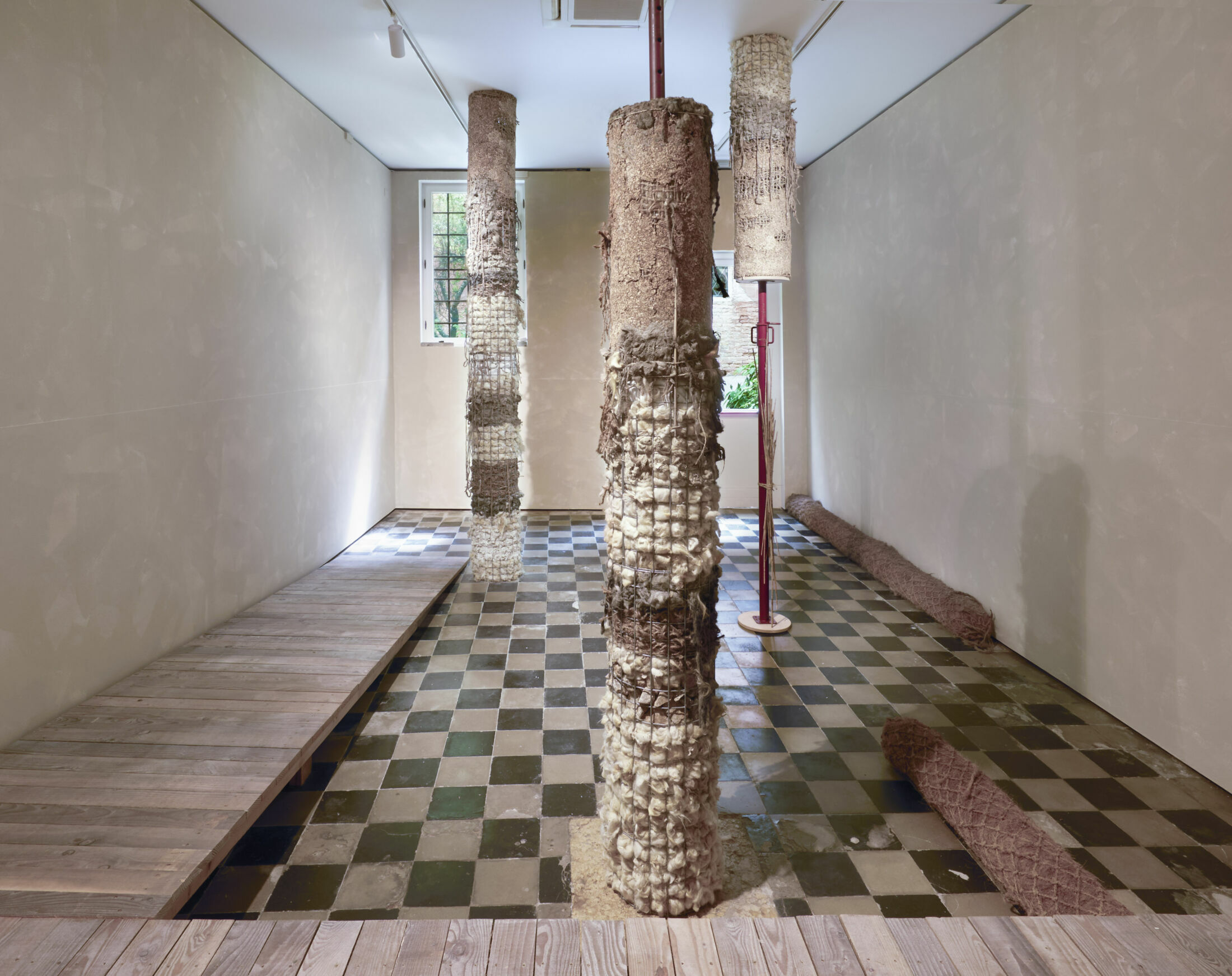
Photo credit Dewi Tannatt Lloyd
The Wales in Venice exhibition is presented at Istituto Santa Maria della Pietà, within accessible walking distance to the main Biennale Giardini and Arsenale sites.
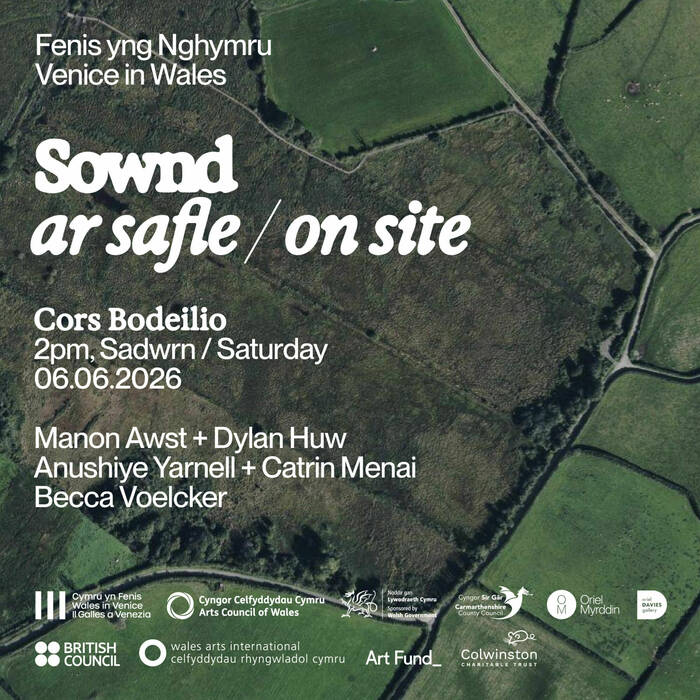
Three site-specific events in Wales will run in parallel with the presence as a collateral event of the 61st International Art Exhibition – La Biennale di Venezia. (more info here)
Sownd combines organic and geological matter from north Wales and the Venetian Lagoon with words, sounds and sculptures responding to the venue's unique architecture. The title Sownd – meaning both “stuck” and “structurally sound” – reflects the artists' collaborative research on the unstable grounds of Welsh peatlands and the fragile ecologies of the Venetian lagoon. These sites underpin a tactile exploration of the precariously layered histories held within minoritised language cultures.
Their collaboration invites connections across borders, resonating with other minoritised languages and communities. Informed by Wales' celebrated history of site-specific collective practice and poetic tradition, Sownd proposes an architecture of entanglement—where material, linguistic, and ecological threads converge to move beyond the limitations of the present.
The exhibition’s main sculptural device is a wooden boardwalk which guides visitors through the installation’s three rooms, designed with the Caernarfon-based architecture studio, PegwA. It echoes the paths found on wet, boggy grounds, and Venice’s passerelle, temporary walkways installed when the city faces high water. The boardwalk culminates in a spatial sound installation, made with collaboration from Freya Dooley and Catrin Menai, circling a fourteenth-century poem by Dafydd ap Gwilym. Other collaborators on the installation include the bio-design studio Tŷ Syml and We are here Venice, a research collective and activist platform dedicated to the conservation of Venice as a living city.
Cymru yn Fenis / Wales in Venice is commissioned by the Arts Council of Wales with support and collaboration from the Welsh Government, Wales Arts International and the British Council. Sownd [ar safle] / Sownd [on site] is further supported by the Colwinston Charitable Trust and Art Fund
Team Bios
Dylan Huw is a writer and artist who works collaboratively across languages and disciplines. Recent projects have been supported by Jerwood Foundation, Artes Mundi, LUX and Mostyn. His critical writing has been published with Frieze, e-flux and Art Monthly, and he has been twice-shortlisted for the International Award for Art Criticism.
Manon Awst is an artist living in Caernarfon, Wales, whose sculptural and performative practice is rooted in specific sites. A recent Henry Moore Institute Research Fellowship and Future Wales Fellowship allowed her to develop creative research on peatlands. Her work is part of the National Library of Wales, the UK Government and Welsh Parliament art collections.
Steffan Jones-Hughes is the Director of Oriel Davies Gallery and Curator of Sownd. Oriel Davies is a key public art gallery of Wales, based in Newtown, rural Powys, mid-Wales. Established in 1982, it presents world-class, thought-provoking and challenging art by national and international artists in an environment that is welcoming, engaging, informative and free.
Catherine Spring is Oriel Myrddin’s Creative Producer and Exhibition Director for Sownd. Oriel Myrddin Gallery is a centre for contemporary visual art, craft and design, located in Carmarthen, south-west Wales. Since 1991, it has been a place for local and international audiences to engage with contemporary ideas through a diverse programme of the visual and applied arts.
Elliott Flanagan is the Curatorial Associate for Wales in Venice 2026. He provides curatorial support and coordination for the development and delivery of Sownd, and works on national programming related to Cymru yn Fenis at sites across the country. His role is supported by ArtFund.
Lily T Wells is the Engagement Associate for Wales in Venice 2026. She supports Oriel Davies and Oriel Myrddin and the artists in the development, production, and delivery of the associated public programming in Wales. Her freelance role is supported by The Colwinston Trust.
Sownd: An Architecture of Unstable Ground
Curatorial Essay for Cymru yn Fenis / Wales in Venice 2026
Steffan JonesHughes
---
I. Approaching the Threshold
To enter Sownd is to step into a world where the ground is never quite solid. The wooden boardwalk that carries visitors through the installation is both a practical structure and a conceptual device: a reminder that we are moving across terrain that is shifting, layered, and alive. As the artists write, “Everything within the work is sculptural — including language,” and this principle shapes the entire environment.
Sownd is not an exhibition of discrete works but a single, continuous ecology — a living installation that accumulates, sediments, and transforms over time.
The title itself, a Cymraeg/Welsh word meaning both “stuck” and “foundationally sound,” captures the paradox at the heart of the project: the tension between precarity and resilience that defines minoritised languages, fragile ecologies, and the cultural histories embedded in the Welsh landscape.
---
II. Peatlands: The World Beneath the World
The conceptual ground of Sownd is the Welsh peatland — sticky, unstable, and ancient. These bogs, the artists note, “conceal and reveal vast scales of material history,” functioning as archives where organic matter and cultural memory accumulate over millennia.
Alys Fowler, in her book Peatland, describes bogs as living, relational systems: places where water, moss, soil, and time interweave in slow, intricate processes. She writes of the sensation of walking on peat — the softness underfoot, the subtle give of the ground, the sense of being held by something both fragile and deep. This embodied experience resonates with the boardwalk’s choreography in Sownd, which guides visitors across “unstable ground” while making them acutely aware of the material beneath.
Carwyn Graves’ book, Tir, offers a complementary perspective, framing the Welsh landscape as a cultural archive shaped by centuries of human practice, linguistic memory, and ecological adaptation. Graves reminds us that landscapes are not passive backdrops but active records — places where histories are held in soil, vegetation, and naming. Sownd extends this argument into a sculptural register, treating peat not only as ecological matter but as a metaphor for the sedimented histories of language and identity.
---
III. Portals, Otherworlds, and the Logic of Liminality
Peatlands have long been understood as thresholds. In medieval Welsh cosmology — echoed in the Mabinogion — bogs and marshes were portals to Annwn, the otherworld. The exhibition’s sound piece, which refigures the medieval poem Y Pwll Mawn, draws directly on this tradition: a lovelorn poet stranded on a peat pit at night, caught between worlds. The bog becomes a site of vulnerability and revelation, a place where the boundaries between the living and the dead, the past and the present, the visible and the invisible, dissolve.
This logic of parallel realities finds a contemporary echo in the “Upside Down” of the Netflix series Stranger Things: a shadow ecology beneath the surface, shaped by decay, memory, and unseen forces. Like the Upside Down, peatlands hold a world beneath the world — a place where time behaves differently, where histories are preserved and distorted, where the ground itself becomes a portal. Sownd invites visitors to sense this doubleness, to move between layers of reality.
---
IV. Language as Material, Language as Magic
If peat is the material archive of the land, language is its living counterpart. In Sownd, Welsh and English echo through the sound installation, not as translations but as parallel presences. This treatment of language resonates with Ursula K. Le Guin’s Earthsea, where the Old Speech — the language of true names — is not symbolic but worldshaping. Naming is an act of creation, responsibility, and relation. In Sownd, Welsh operates similarly: not as a cultural artefact but as a sculptural force embedded in the land itself.
The exhibition’s sampling methodology — its gathering of fragments, its layering of temporalities, its refusal of closure — mirrors the narrative logic of the Mabinogion and the mythic shapeshifting of figures like Gwydion and Rhiannon. Language here is not fixed but fluid, capable of transformation, recomposition, and survival.
---
V. Entanglement: A Queer Ecology
The exhibition’s emphasis on entanglement resonates strongly with Tim Morton’s writing on queer ecology, which challenges the boundaries that traditionally separate nature from culture, past from present, and human from non-human. Morton argues that ecological thinking requires a queering of categories — an acceptance of the messy, interdependent, and often unstable relations that shape our world.
Sownd enacts this logic. The gabion pillars in Room 2 — “close to bursting with ‘stuff’” — are composite bodies of knowledge, filled with geotextiles, grasses, paper, rope, earth, gravel, and research materials. They are “strange strangers” in Morton’s sense: entities we can never fully know, yet must learn to live with. The space, imbued by these materials, becomes a record of entanglement. The sound installation, with its shifting voices and layered temporalities, queers the linearity of narrative and the stability of identity.
As curator, I also draw on the Design Museum’s catalogue More than Human: Making with the Living World, which argues for a shift from designing for nature to designing with it. This perspective illuminates the installation’s attention to ecological processes, material interdependence, and the agency of non-human systems. Like the projects documented in the Design Museum catalogue, Sownd resists anthropocentric narratives, instead foregrounding collaboration, reciprocity, and the slow intelligence of landscapes such as peatlands.
---
VI. Atmosphere, Materiality, and the Architecture of Feeling
There is a Zumthor-like sensibility to Sownd’s spatial composition. Peter Zumthor writes of architecture as atmosphere — a field of sensations, memories, and material presences. He describes how certain spaces “touch me with their materiality,” how wood, stone, and light can create an emotional temperature.
The boardwalk in Sownd operates in this register: its softwood surfaces, its relation to the holes in room 3, its shifts in height and width, all choreograph a sensory encounter with the installation’s unstable ground. Like Zumthor’s atmospheres, Sownd invites visitors into a space that is felt as much as understood, where material, sound, and language converge to produce a quiet but insistent intensity.
Here, I also draw on Tim Ingold, whose writing on making, materials, and the “meshwork” of life offers a powerful lens for understanding the installation’s relational sensibility. Ingold argues that materials are not passive substances but active participants in processes of becoming — always in motion, always in relation. This resonates with the gabion pillars, the boardwalk, and the sound that seeps through the space. In Ingold’s terms, Sownd is less an arrangement of objects than a field of correspondences, where human and non-human forces cocompose the environment. This is my curatorial framing, offered to illuminate the work’s morethanhuman dynamics.
---
VII. Invisible Structures, Composite Worlds
There is also a Calvino-like quality to Sownd’s architecture — a lightness that does not diminish depth, but instead allows materials, languages, and histories to circulate with new relational force. Like the cities of Invisible Cities, the exhibition unfolds as a constellation of fragments: objects, sounds, and texts that form a composite world built from memory, ecology, and imagination. Calvino reminds us that the structures shaping our lives are often invisible — currents, stories, names, sediments — and Sownd makes these structures tangible.
The grid of found objects in Room 1, the compressed pillars in Room 2, the layered sound in Room 3, and the reflective space in Room 4 together form an archipelago of encounters. Each room is an island; the boardwalk is the current that connects them.
---
VIII. Toward a Future That Remembers
In an era marked by ecological crisis, linguistic erosion, and cultural fragmentation, Sownd offers a different model of attention — one that is slow, layered, and relational. It asks what it means to inhabit a world where nothing is permanent, where the ground itself trembles, and where histories are always in the process of being rewritten.
The exhibition proposes that resilience lies not in solidity but in entanglement. Like peatlands, like minoritised languages, like the stories of the Mabinogion, like the cities of Calvino, like the Old Speech of Earthsea, Sownd is a world built from fragments — a world that persists through relation.
It invites us to listen to what lies beneath the surface.
To sense the world beneath the world.
To find, within the unstable ground, something foundationally sound.
![Sownd [on site]](/imager/images/139471/Sownd_General-ENG_e34fcca8c14244ae8a504b7351010aca.jpeg)